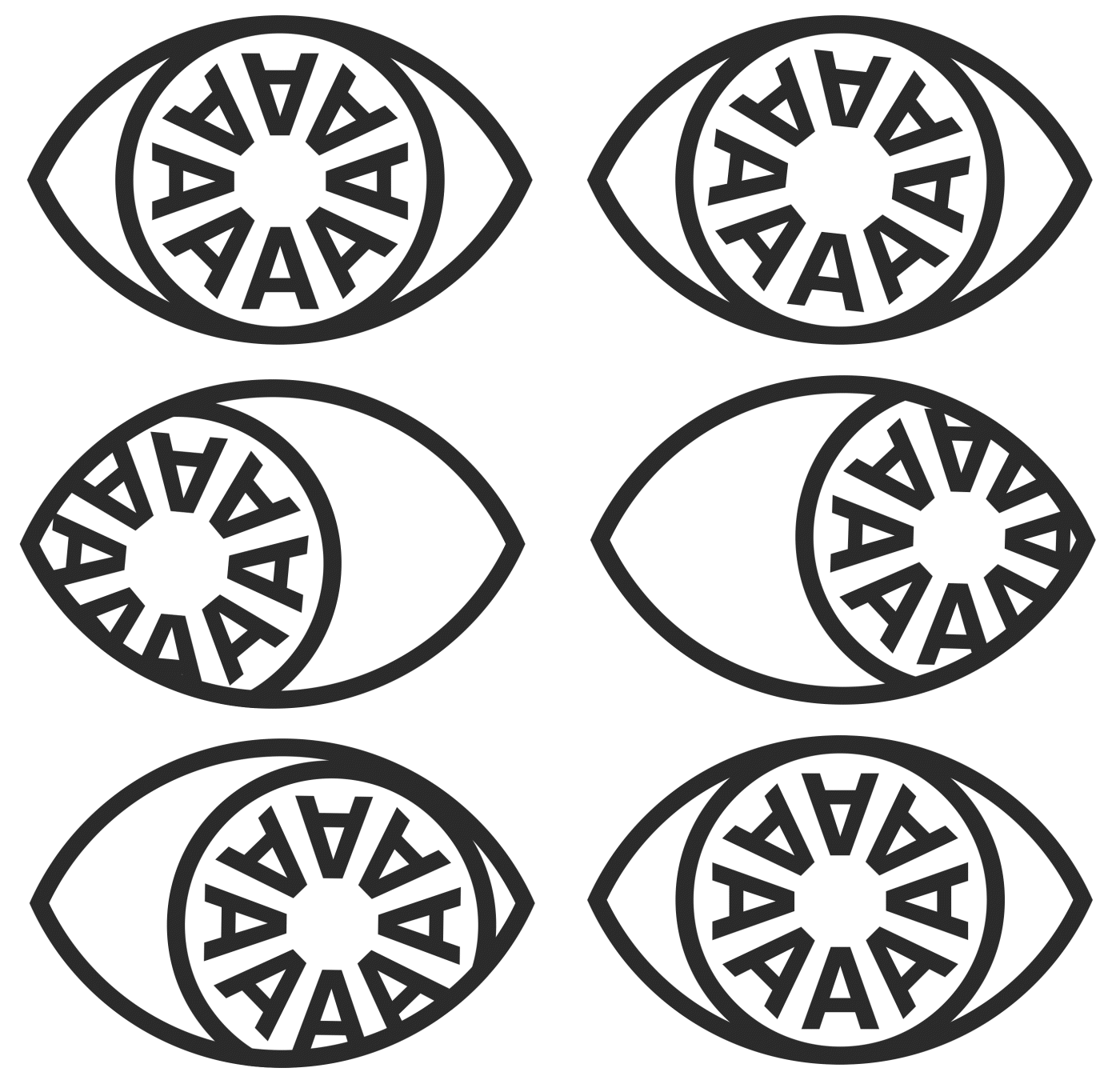


'If we continue to allow AI to do our imagining for us, we will lose our ability to dream'.
'Weapons of Mass Convenience'
'Cognition' - Pencil on paper, tonal study by Thomas Atkinson
Working with AI to boost productivity is now an industry standard and the rapid growth of this technological capability is exciting and useful. Yet, in our modern digital dwellings, creator and audience alike, we seem to be craving a human component to our communications. This is partly because it’s too convenient for our own good and we’re relying on it to the detriment of many aspects of our humanity; including honest labour, craft, hard work, dedication, education and imagination.
AI is becoming increasingly competent and its capacity to generate material resembling organic communications is developing with its growing frame of reference to large language models. It would seem that this creates a problem for people in careers that would otherwise be performing the same labours that AI is beginning to replace. Unfortunately, this is unavoidable as businesses explore the efficiency of this new technology, and the associated economical advantage it can provide for businesses functioning in a competitive market. It does this by flattening the skill curve at the lower end, making simple tasks reproducible by most, increasing consistency and speed of production. This is an argument for the acceptance of AI in the role of business, however we must consider that all it has done is raise the bar at the lower end. Now, with AI, you don't need much skill to create something decent, but you still need a lot of skill to create something exceptional. New ground will not be broken if all that is taking place is a recapitulation of ground already gained.
We ought to put AI in its place. It does not make high-level conceptual thinking any easier, it just automates subprocesses. We could think of AI as an intermediary technological structure, like the assembly robots in car production. This efficient technology does not negate the need for concepts, strategy, and great minds to do the kind of thinking and exploration required for creative excellence.
Why can't we fully automate the process of creative exploration?
Intuition and impulse are concepts of mind which point to phenomena too deep to articulate explicitly. Dreams are also in the category of ‘subconscious’. Although more abstract in tone, subconscious events are causally linked to conscious productions. For example, the melody for The Beatles song ‘Yesterday’ came to Paul McCartney in a dream, he later told reporters. So we can see that there's more to the human experience than what can be consciously articulated. Here lies the problem- because AI is constructed from information that we have codified from a conscious level,
it lacks the sufficient depth needed in the process of human development.
Not only this, but we can sense it.
What AI lacks in it's reproductions is felt in the form of scepticism. If you want to test this, watch yourself as you try to figure out if the face in the advert you are watching is artificially generated. We tend to be sceptical about things which we do not trust, and without trust we don’t buy. Nobody wants to feel tricked.

Opinion article by Thomas Atkinson, 2025
We therefore fail to connect wholly with the subject; as a result we cease to engage with it. What we require for acceptance is similarity- recognition of self in otherness. It is for this reason that part of what makes work great is seeing the human or artist in the result. Like the emotional strokes of a Jackson Pollock painting.
It is the task of getting AI to create the right thing which is key; just because something is travelling fast, does not mean it is bound to the correct destination. It is the responsibility of the individual to don their long-distance binoculars, and conduct the growth of Artificial Intelligence in the right direction. This is achieved by having good taste and asking the right questions, human questions.